
WHY DOES BROWN CHAPEL MATTERS
HISTORICAL SIGNIFICANCE FOR RESTORATION
The Historic Brown Chapel AME Church Preservation Society, Inc. Foundation (HBCPSFoundation) is significant because it is the non-profit organization in which contributors can make tax-deductible contributions and every dollar contributed goes to support its stated mission. To date,
the Foundation has received significant financial support from the National Park Service, National Trust, and the Alabama African American Civil Rights Heritage Sights Consortium. We are grateful for the support of these organizations, which have helped tremendously with immediate and necessary repairs.
The church’s notoriety stems from the role it played in the Voting Rights Movement in the 1960’s. When then Governor George Wallace ordered the courts to issue an injunction prohibiting mass meeting in Black Churches, Pastor P. H. Lewis and Bishop I.H. Bonner provided Brown Chapel as a place to gather and plan next steps to protest civil rights and voting rights. With great risk and sacrifice, before and leading up to March 7, 1965, which infamously became known as “Bloody Sunday,” Brown Chapel served as a haven, giving hopeful citizens hope and optimism. In addition to Brown Chapel being considered the “Mother A.M.E. Church of Alabama,” the church’s leaders and congregants challenged societal injustices of that time and still serves as a guiding compass of the day.Because of the church’s history and what it has stood for since 1965, people have come from across the nation and world to Brown Chapel the first Sunday in March of each year to celebrate and remember Bloody Sunday.
Termite Damage
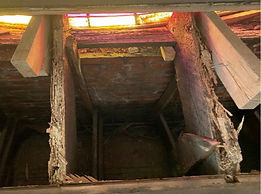

Structural Damage


WATER DAMAGE


Since our inception, we’ve worked around the clock to preserve our church and heritage. Every contribution goes toward maintaining its beauty and historical significance. Making a positive monetary difference is needed, and very much appreciated.
SIGNIFICANT WORK THAT REMAINS
-
Replace Aging HVAC Systems
-
Upgrade Electrical Service
-
Modernize and rewire lighting and fixtures
-
Restore Restrooms to Meet ADA Requirements
-
Complete Restoration of North Balcony
-
Restore South and East Balconies
-
Finish Restoring North Balcony
-
Install glass railings at all balconies to meet safety requirements
-
Repair/restore north and south bell tower stairs, stair landings and ceilings
-
Repair/restore stained glass window frames and glass
-
Repair/restore interior walls, metal ceiling and wood floors
-
Refinish woodwork
-
Repaint interior walls and exterior brick and finishes
SIGNIFICANT WORK COMPLETED
-
Stabilized the Church’s Foundation
-
Partial repair of North Balcony
-
Replaced/installed New Roofing
-
Repointed exterior bricks
-
Termite Treatment
-
Rebuilt belltowers and cupolas
HOW CAN WE HELP RESTORE?
With the passage of time and sharing this iconic building with local, regional, national and visitors from around the world, the church’s age and usage have caused it to need significant repair. You can help by contributing to the Foundation. And you can be assured that every dollar of your contribution will be used for the repair and restoration of the church as all board members are volunteers.
A NATIONAL HISTORIC LANDMARK
Brown Chapel AME Church was built in 1908 by architect A. J. Farley, a former slave, in a Romanesque Revival style. On Sunday, March 7, 1965, marchers, including the late Congressman John Lewis, left Brown Chapel to march to Montgomery protesting the right to vote. However, on that day, marchers attempted to cross the Edmund Pettus Bridge but were met by state troopers on horseback and with dogs and were beaten back across the bridge. Many marchers were severely injured and returned to the church for care and comfort. Television images of the event went across the nation and the world, and brought light to Selma, AL and voting disenfranchisement of African Americans. This day led President Lyndon B. Johnson to sign the Voting Rights Act of 1965, and it infamously became known as “Bloody Sunday.” In 1997, Brown Chapel AME Church was declared a National Historic Landmark, and in 1982, it was declared a State of Alabama Historic Landmark.